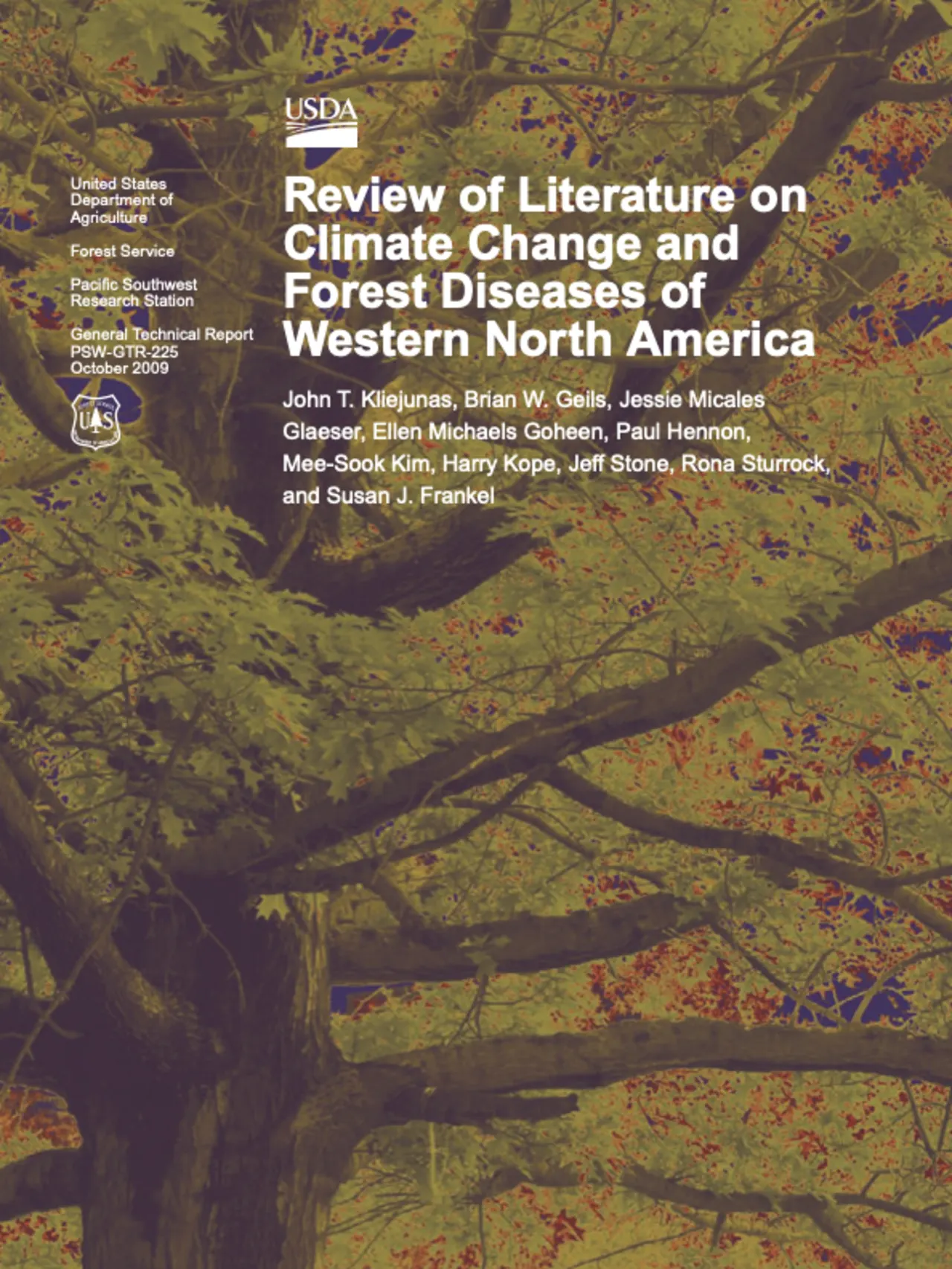
Review of Literature on Climate Change and Forest Diseases of Western North America
Source
Author
About This Report / White Paper
Review of Literature on Climate Change and Forest Diseases of Western North America offers a detailed summary of the relationships between climate and various types of tree diseases and the potential effects of climate change on pathogens in western North American forests. Although we are uncertain how specific forest pathogens will respond to climate change, existing knowledge allows us to draw some general inferences. Summarized, these include:
• The distribution of pathogens and diseases, and their influence on the status and trend of forests, will change. Increases in temperature may allow some diseases to expand their latitudinal and elevational ranges. The influence of pathogens on the status and function of forests may change coincident with changes in species composition and climate. If managers facilitate migration of tree species to new locations, we should expect new diseases to affect those trees.
• Climate change will alter the epidemiology of plant diseases. Prediction of disease outbreaks will be more difficult in periods of rapid climate change and unstable weather.
• In a rapidly changing climate, the rate at which pathogens evolve and overcome host resistance may increase.
• Because abiotic factors such as temperature and moisture affect host susceptibility to pathogens and pathogen aggressiveness, changes in interactions between biotic diseases and abiotic stressors may represent the most substantial effect of climate change on plant diseases.
• Climate change may facilitate invasion by new nonnative pathogens. New epidemics may occur as a result.
• Many pathogens currently are limited by winter temperature, and seasonal increases in temperature are expected to be greatest during winter. Accordingly, both overwintering survival of pathogens and disease severity are likely to increase.
• The effects of climate change on individual plant diseases will depend on the ecosystem and climate conditions.
Disclaimer
These resources are provided "as is" for informational purposes only, without warranty of any kind. They do not constitute legal or professional advice and do not create an attorney-client relationship. They may not reflect current legal developments and should be adapted for your organization with qualified professional help. The Alliance is not liable for any damages arising from use of or reliance on these resources. Views in individual posts and third-party links/logos are not Alliance endorsements. The Alliance is committed to equal opportunity and does not condone unlawful discrimination.
For accreditation-related materials, please also consult the Land Trust Accreditation Commission website.