High-wire act: As energy development accelerates, land trusts balance the conservation impacts
Source
Author

About This Saving Land
Data centers, transmission lines and large-scale renewable energy facilities all require large tracts of land. Land trusts are uniquely positioned to proactively engage and guide infrastructure siting decisions that benefit land, communities and climate.
Check out the Alliance's Energy Infrastructure Siting Toolkit in addition to this story.
Meghan McDonald is a freelance writer focused on science, sustainability and community impacts.
© 2026 Land Trust Alliance, Inc. All rights reserved.
Disclaimer
These resources are provided "as is" for informational purposes only, without warranty of any kind. They do not constitute legal or professional advice and do not create an attorney-client relationship. They may not reflect current legal developments and should be adapted for your organization with qualified professional help. The Alliance is not liable for any damages arising from use of or reliance on these resources. Views in individual posts and third-party links/logos are not Alliance endorsements. The Alliance is committed to equal opportunity and does not condone unlawful discrimination.
For accreditation-related materials, please also consult the Land Trust Accreditation Commission website.
What do data centers, transmission lines and large-scale renewable energy facilities have in common? They require huge tracts of land and, if not sited wisely, could impact critical places needed for agriculture and conservation, including for biodiversity and clean water.
Data center electricity demand, which could triple by 2028, is a driving factor in what could be a 25% rise in overall U.S. electricity demand by 2030. The nation’s push for leadership in energy and artificial intelligence, supported through federal initiatives such as Speed to Power, is accelerating large-scale infrastructure development proposals in and around high-value conservation lands.
“There’s real opportunity for land trusts across the country to engage proactively with policymakers, utilities and developers to integrate conservation priorities into decisions about where to site these facilities,” says Andrew Szwak, the Land Trust Alliance’s Mid-Atlantic senior program manager. He works regularly with organizations in Virginia, which has the largest concentration of data centers in the world plus renewable energy goals written into law.
“Rapid, unchecked development — even if it’s renewable energy, which is essential in the fight against climate change — can create damaging, unintended consequences,” adds Kelly Watkinson, director of the Alliance’s land and climate program. “The land trust community is well-positioned to help guide infrastructure siting decisions that benefit land, communities and climate.”

Sizing up the challenge
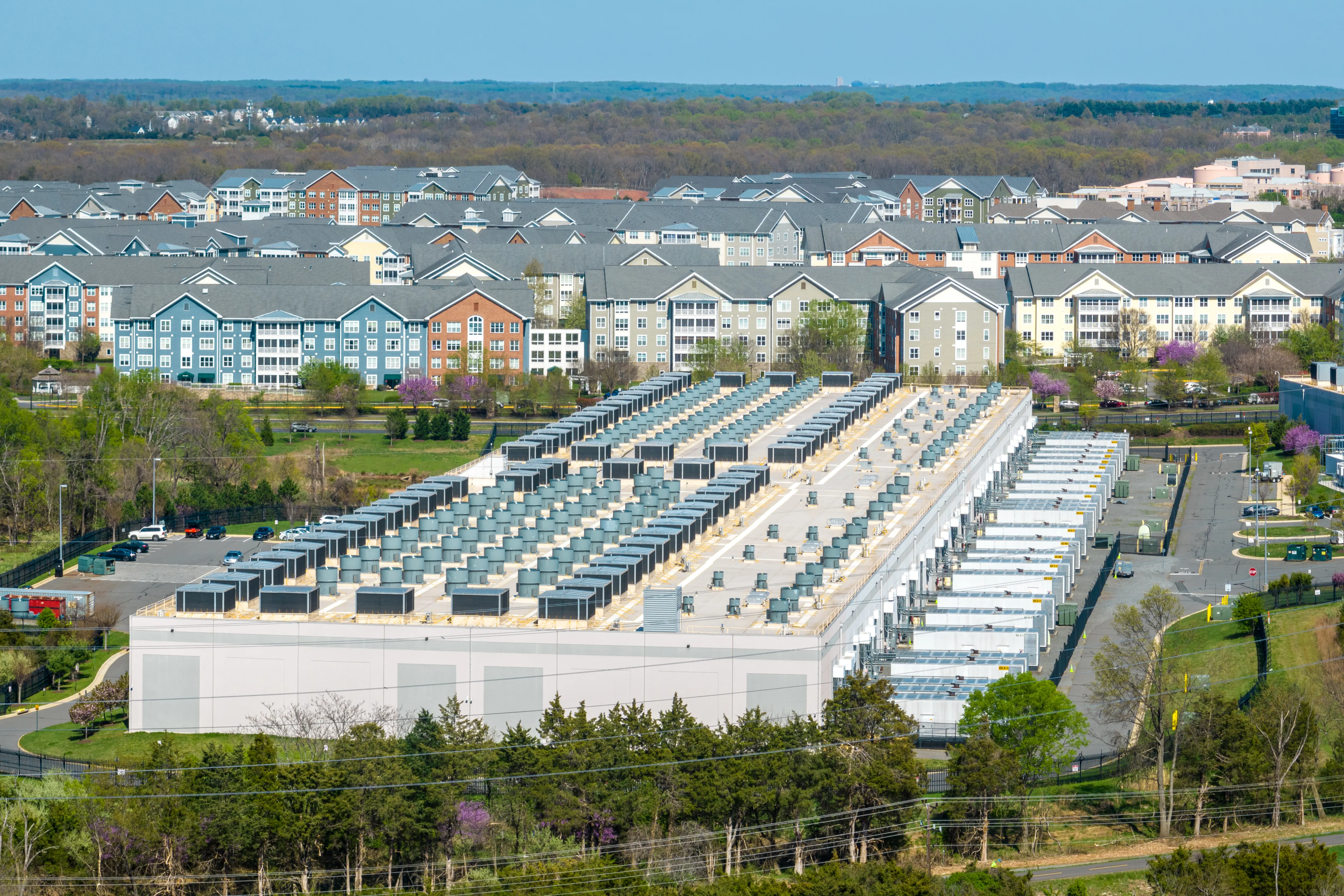
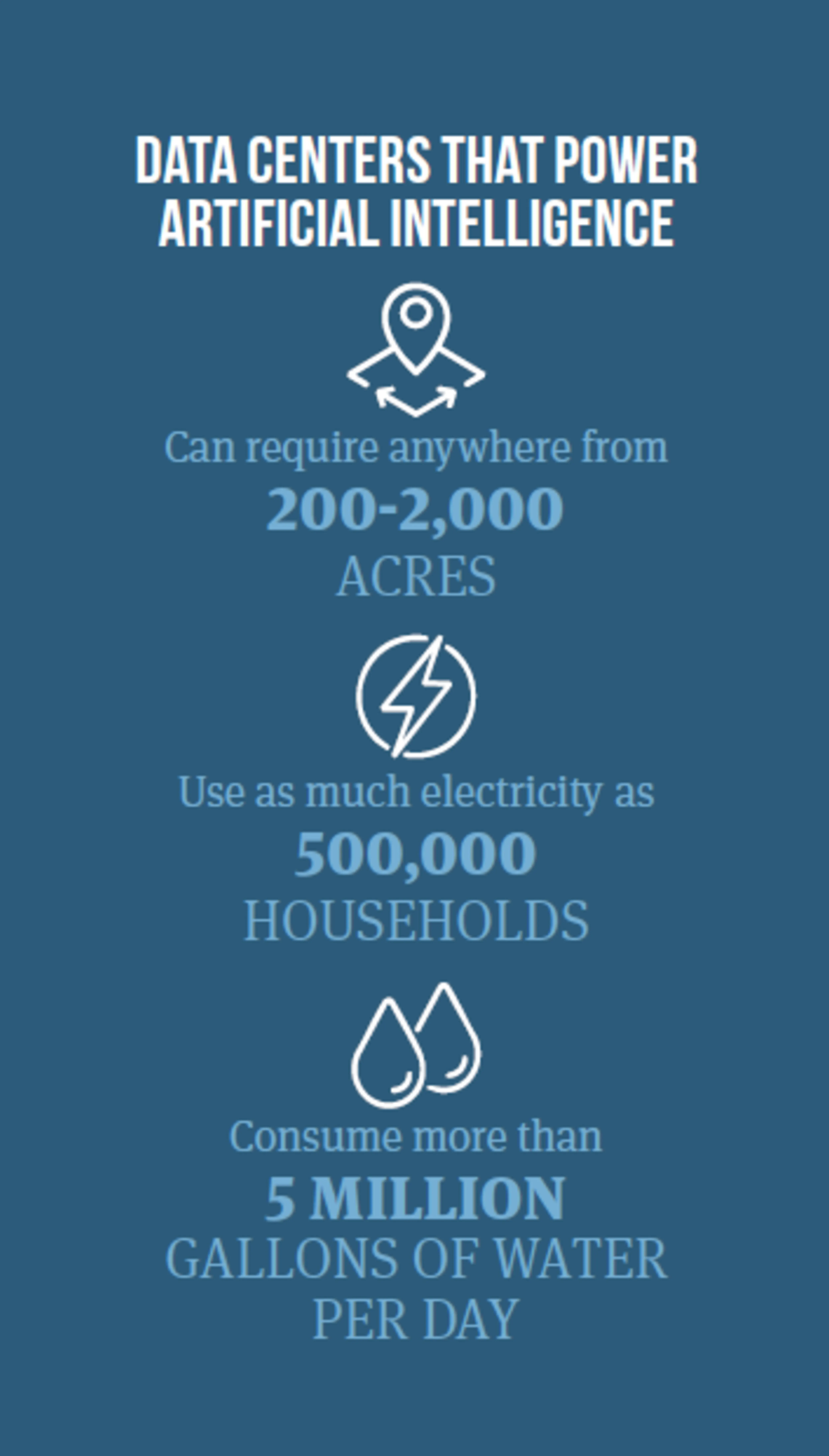
The largest solar and wind facilities in the U.S. cover thousands of acres. “Hyperscale” data centers that power artificial intelligence can require anywhere from 200 to 2,000 acres, use as much electricity as 100,000 households and enormous amounts of water — in 2023, U.S. data centers directly consumed more than 17 billion gallons of water, impacting drinking water, wildlife habitat, river and lake ecology, and agricultural systems. And transmission lines associated with either type of facility can cover miles — and may end up slicing through conserved land.
A poorly sited infrastructure project can fragment ecosystems, alter water drainage patterns, degrade prime farmland and ignore local land-use priorities. Loss of carbon-storing forests can undermine renewable energy’s climate benefits.
“Infrastructure siting will affect us all eventually, even if there’s no data center across the street,” Szwak says. “I’ve seen land trusts thrust unprepared into this realm when a large-scale proposal suddenly threatens a property,” he adds. “The more proactive land trusts can be, the more likely they are to have a positive influence.”
Szwak advises networking with peers, building rapport with local experts in utility regulations and energy systems, and participating in local planning and state policymaking processes.
Midwest senior program manager MaryKay O’Donnell is seeing large-scale infrastructure move into her region too. “Land trusts can’t ignore this, but shouldn’t panic, either,” she says. “Get your board involved and start defining your position: What makes a site good or bad for large-scale infrastructure? In what ways are you willing to channel your resources to engage? Where can you plug into relevant coalitions?”
“Infrastructure siting is incredibly complex, but land trusts can bring so much to the table,” O’Donnell says. “They understand real estate, title law, planning, coalition building and the science behind why properties are protected. That’s all relevant.”
“And,” she adds, “land trusts have skills and expertise to propose smart strategies to avoid high-value conservation land, minimize negative impacts and mitigate what can’t be avoided or minimized.”
How are land trusts learning to apply those skills and expertise? Four organizations around the U.S. describe their diverse insights and approaches.
Supporting conservation and community priorities
The Columbia River Gorge National Scenic Area straddles the border between Washington and Oregon. This 80-mile-long strip of the Gorge is home to endangered salmon and hundreds of wildflower species, including 15 that live nowhere else in the world.
Friends of the Columbia Gorge, the scenic area’s advocacy organization, established an accredited land trust in 2005. “Friends of the Columbia Gorge land trust preserves sensitive lands and stewards public preserves. They brought community partners together to create a vision for a 200-mile trail system,” says Friends Executive Director Kevin Gorman.
As the only sea-level passage through the Cascade Mountains, the Gorge is a historic travel corridor. “Now it’s become an energy corridor, with dams, transmission lines and, more recently, wind turbines just outside the scenic area boundaries,” Gorman says. “We’re trying to support renewables while protecting scenic, natural, cultural and recreational resources.”
That support takes multiple forms, from state-level policy advocacy to successfully working with a wind developer to alter their site plans so turbines would not be visible within the scenic area.
The expanding energy infrastructure in counties along the Gorge is attracting data centers. “The lack of transparency into their impacts on natural resources is a big concern here,” Gorman says.

In 2023, when a data center was proposed for the small town of Cascade Locks, Oregon, the developer and local officials met behind closed doors. The developer publicly claimed the data center’s energy load wouldn’t increase local electricity rates; the mayor claimed the opposite. Potential water impacts weren’t clear.
“Community members started mobilizing against the data center—they felt it was too speculative. But they didn’t know how to get the word out,” Gorman says. “Rather than carry the flag for this issue, Friends decided to provide technical guidance and make sure community voices were heard.”
Gorman recommended community activists get the local publication Columbia Insight to investigate the project. The resulting articles unearthed the developer’s history of failed business ventures and revealed the data center’s energy load would factor into higher local electricity rates.
With more information available, the town scrapped the proposal.
Forty miles east of Cascade Locks, The Dalles has continued to welcome data centers. While they bring jobs and tax revenue, they also consume about one-third of the city’s water. The city now aims to triple the size of its water reservoir — although it says these plans are unrelated to data centers. Its proposed strategy would significantly affect a nearby national forest and Columbia River tributaries. Friends is watching for the right opportunities to engage, whether in the background or in a more visible role.
“Land trusts need to be civically engaged in our communities,” Gorman says. “Part of the concept of ‘community conservation’ is making sure communities are thriving and that their systems work in concert with conservation goals. Our communities’ everyday decisions will eventually impact our ability to steward land and water resources.”


Cultivating dialogue with developers
Tall Timbers, a research station and accredited land conservancy, works across the greater Red Hills region of north Florida and southwest Georgia. The area is one of America’s few remaining hotspots for wild bobwhite quail.
“Our previous strategic plan, written in 2015, didn’t include the words ‘utility-scale solar.’ It wasn’t on our horizon,” says Planning and Advocacy Coordinator Neil Fleckenstein. “But by 2020, it was the No. 1 land use issue for us.”
Tall Timbers had an abrupt introduction to the topic when a developer clear-cut a longleaf pine forest to build a solar facility. “That certainly got our attention,” Fleckenstein says. The organization began working with several county governments to develop site decision guidance.
A few years later, a landowner who donated a 1,000-acre conservation easement learned that a 3,000-acre solar facility was being proposed next door. Concerned, both the landowner and Tall Timbers got involved in local permitting and approvals processes. They first met the developer’s representative at a county commission meeting.
Tall Timbers seized the opportunity, not to fight the developer, but to build ongoing dialogue.
“Silicon Ranch takes their status as a long-term neighbor seriously,” Fleckenstein says. “Over the next year, we talked about potential impacts to easement habitats. We asked for, and they agreed to, an enhanced vegetative buffer between the properties, native plantings and working with our landowner to use prescribed burns. The relationship made this possible.”
“Our engagement with organizations such as Tall Timbers helps us better identify stewardship opportunities and understand how to optimize them in ways that benefit both our project sites and the surrounding communities,” explains Loran Shallenberger, vice president for regenerative energy and agrivoltaics at SR.
Fast-forward to 2026. SR proactively notifies Tall Timbers about proposed projects located near easements. Tall Timbers, which has served SR as a resource for gopher tortoise management and prescribed burns, is preparing to recommend mitigation strategies for a new project. They’re also talking with Duke Energy in Florida about how to protect working rural lands and scenic views as the utility plans new solar facilities.
“We have to open the door to dialogue ourselves,” says Tall Timbers planner Ben Naselius. “When we do, nearly all the companies we’ve contacted have been receptive to talking. This won’t always be the case, but you don’t know if you don’t try.”
Tall Timbers created its Board Position Statement to define what smart siting and mitigation strategies mean to them. They also helped create recommended practices for solar siting and design as part of the Georgia Utility Scale Solar Siting Initiative Partnership, a collaboration among conservation groups, utilities, solar developers and government agencies.
“We’re seeing greater benefits,” Fleckenstein says, “by being proactive and engaging at multiple levels: representing our landowners, forming relationships with companies doing business in our backyard and working with local governments and other NGOs.”
Mid-Michigan Land Conservancy is a small, accredited land trust comprised of an executive director and a volunteer board of directors. The new owner of one of MMLC’s oldest conservation easement properties received a tantalizing offer: let a utility build a solar facility on his farmland and earn more than $100,000 annually.
MMLC had to determine whether the use was allowed under the terms of the easement and, if not, whether the landowner’s amendment request would meet best practices as articulated in the Alliance’s publication Amending Conservation Easements.
“When the easement agreement was written, there was no thought of solar,” says board member Kenneth Rosenman. Although Michigan’s Department of Agriculture considers solar on farmland as an agricultural land use, could a utility solar facility be deemed a prohibited commercial development according to this easement? “It wasn’t a clear decision,” adds Rosenman.
For existing easements, the language of the easement itself dictates whether renewable siting is permissible or not. Since many easements prohibit structures outright, renewable siting is often not an option. Land trusts must also analyze numerous other clauses of an easement, such as restrictions on commercial use, grading and vegetation removal. MMLC’s board worked with Alliance experts to identify and navigate these issues.
One important question arose, says Rosenman: Would granting the landowner’s request to site large-scale solar on a conservation easement property result in the conservancy, a charitable organization, impermissibly benefiting a private party? Prohibitions on impermissible private benefit are set forth in federal tax law for charitable organizations and are designed to ensure that charitable assets are used to further public (or charitable) purposes, not private ends. Violation of private inurement and private benefit rules could result in monetary penalties and, in extreme cases, loss of the charity’s tax-exempt status.
After a thorough analysis, including preparation of necessary documentation to properly answer the question of impermissible private benefit, MMLC’s board determined that an alternative path should be found. (For more on how to conduct this analysis, see the Alliance’s practical pointer Private Inurement and Impermissible Private Benefit Prohibitions.)
As of autumn 2025, the landowner was negotiating a new option with the utility to site the facility on a nearby property he owned.
“We’ve learned to proactively address solar in new conservation easement agreements,” says Rosenman. “If the landowner desires, we can allow for the possibility under the right conditions.”
Rosenman is helping draft language MMLC can use for future easements. He’s drawing inspiration and best practices from resources like the “Powering Up Conservation” guide created by Colorado Open Lands with a grant from the Alliance, and the Alliance’s practical pointer, Siting Renewables on Conservation Easements: What Land Trusts Need to Know.
When drafting a new conservation easement, land trusts must assess whether renewable energy is an appropriate activity. This is a site-specific question that can only be answered after careful analysis of the conservation values of a given property, in the full context of an individual project and using best practices.
“Land trusts have to address energy development not only from the conservation perspective, but also from the legal perspective for easements,” Rosenman says. “It’s worth thinking about owned land, too. If the utility made us the same offer, the finances would be tempting. But we’d have to carefully investigate, ensuring nothing could jeopardize the land’s conservation values or our nonprofit status.”
Communicating the story of costs and benefits
Piedmont Environmental Council is a grassroots advocacy organization and accredited land trust. Staff stationed in nine Virginia counties work on local issues that ladder up to state and federal priorities. Today, the rapid surge in large-scale renewable energy and data center development and the associated impacts on land use, water resources and Virginians’ energy costs are at the forefront of PEC’s efforts.
“Virginia’s energy system will need to triple in size to serve this one industry,” says Executive Director Chris Miller. “Data center issues are taking up to 30% of all PEC staff time, so we’re very aware of what’s at stake. Eminent domain for transmission lines is a real threat. And without regulatory and legislative intervention, the infrastructure costs will be passed to average Virginians.”
However, relevant infrastructure decision-making processes increasingly take place outside PEC’s counties. PEC advocates for state policies and a regulatory framework that support sustainable energy planning and data center development. The framework would enhance transparency, establish a state-level regulatory review process, protect ratepayers and create a robust mitigation system funded by data center development.
“In 2025, several bills were introduced to the Virginia General Assembly thanks to direct legislative and community mobilization action from organizations like PEC and our partners in the Virginia Data Center Reform Coalition,” Miller says.
With all this work at the state level, PEC decided to extend its communications. Miller made the case to PEC’s board and donors to run statewide digital communications campaigns. “It makes sense. Our conserved lands could be impacted negatively. We have the right skillsets to show Virginians why they will want to pay attention to these issues and how to participate in decision-making processes,” he says.
To create the campaigns, PEC staff quantified and visualized the statistics about Virginia’s data center boom. “Helping people see the aggregate impacts is powerful,” Miller says.
This fits with PEC’s overall approach: increasing awareness of potential community and conservation impacts “so we can avoid, minimize and mitigate those impacts based on transparent and holistic assessments of data centers and infrastructure,” explains Miller.
The ads, articles, social posts and videos reached millions in 2025. Based on key performance metrics, Miller notes, “We can see the campaigns are helping change conversations around these topics.”
PEC’s new campaign, “Pause the Plan,” is running during the General Assembly’s fast-paced 2026 session. “We’re saying ‘pause’ because we’re not pushing for moratoriums or bans. We’re saying, let’s make time for a real conversation about how it will change things. Let’s honestly account for impacts so we can manage them,” Miller says.
“Land trusts are in the forever business,” he continues. “Creating public and policy support for smart infrastructure siting is part of our stewardship and enforcement. It helps make that perpetual investment in conservation truly meaningful.”
"I hope our experiences and the work the Alliance is doing will rally more land trusts to engage early on data center and energy infrastructure development,” Miller concludes.

“Land trusts are in the forever business. Creating public and policy support for smart infrastructure siting is part of our stewardship and enforcement. It helps make that perpetual investment in conservation truly meaningful.”
Powering conservation benefits, together
The scale of infrastructure development can feel daunting, but land trusts of all sizes have valuable skillsets and resources at their fingertips. Together, the land trust community is learning how to apply them to these new challenges.
“It’s time to engage,” says the Alliance’s Kelly Watkinson. “Together, we are developing smart solutions.”
The Alliance has a new renewable energy siting toolkit (read more about it in the sidebar) and many other resources, from practical pointers to peer networks, that can assist land trusts.