Organizations partner to create third largest conservation landscape in the Chicago region
The acquisition of Tamarack Farms will protect high-quality wildlife habitat, wetlands and forested land, including tamarack trees that are living remnants of the last ice age.

This blog was adapted from an announcement by Openlands.
Straddling the Illinois-Wisconsin border is the Hackmatack National Wildlife Refuge, established in 2012 with the initial 12-acre conservation easement donation to the U.S. Fish and Wildlife Service by the accredited Openlands land trust but aiming to improve or restore much more than that ultimately — 11,000+ acres of wetland, prairie and forest habitats.
The refuge’s name, Hackmatack (hack-ma-tack), is an Algonquin word for the tamarack trees found in the refuge area — living remnants of the last Ice Age. The refuge also protects vital habitat for the region’s biodiversity while offering extensive recreational opportunities for the 12 million residents of the greater Chicago, Rockford and Milwaukee metropolitan areas.

Recently, Openlands teamed up with The Conservation Fund and the Illinois Audubon Society to acquire a property known as Tamarack Farms in nearby Richmond, Illinois. Why is this important? At 985 acres, Tamarack Farms is the largest single property located within Hackmatack’s approved boundary, where the average property size is only 63 acres.
“High-quality public land is a boon to McHenry County, as it would be for other parts of the region with natural assets like Tamarack Farms,” said Michael Davidson, president and CEO of Openlands. “From the emergence of Hackmatack in 2005 as an idea, Openlands has championed, with partners, the value proposition of a national wildlife refuge right here in our own metro.”
The acquisition of Tamarack Farms will further protect high-quality wildlife habitat on the property, including remnant oak woodland, habitat for nesting grassland birds and waterfowl, cold-water springs, a 70-acre open water wetland and multiple feeder streams to the nearby Nippersink Creek, one of the highest aquatic quality streams in the region. More than 200 species of birds, 70 species of fish, 30 species of reptiles and amphibians, 35 species of mammals and hundreds of plant species have been recorded within the refuge boundary. The Tamarack property will be held in trust by Openlands and The Conservation Fund until it can be conveyed to the U.S. Fish and Wildlife Service.
“Large-scale conservation such as this project is critical to ensure species’ resiliency in the face of climate change, and Tamarack Farms will provide a natural sanctuary for both people and wildlife,” said Jo Fessett, executive director of Illinois Audubon Society.
According to the Prairie State Conservation Coalition, which maintains a database of all conservation properties in Illinois, Tamarack Farms is the largest conservation acquisition in the Chicago region since the creation of Midewin National Tallgrass Prairie in 1996. Additionally, Tamarack Farms will connect several existing conservation areas, creating a continuous 5,600-acre macrosite — the third largest in the six-county metro region behind Midewin and the Palos Preserves of the Forest Preserves of Cook County, and filling an important gap between Glacial Park to the south and North Branch Preserve to the north.
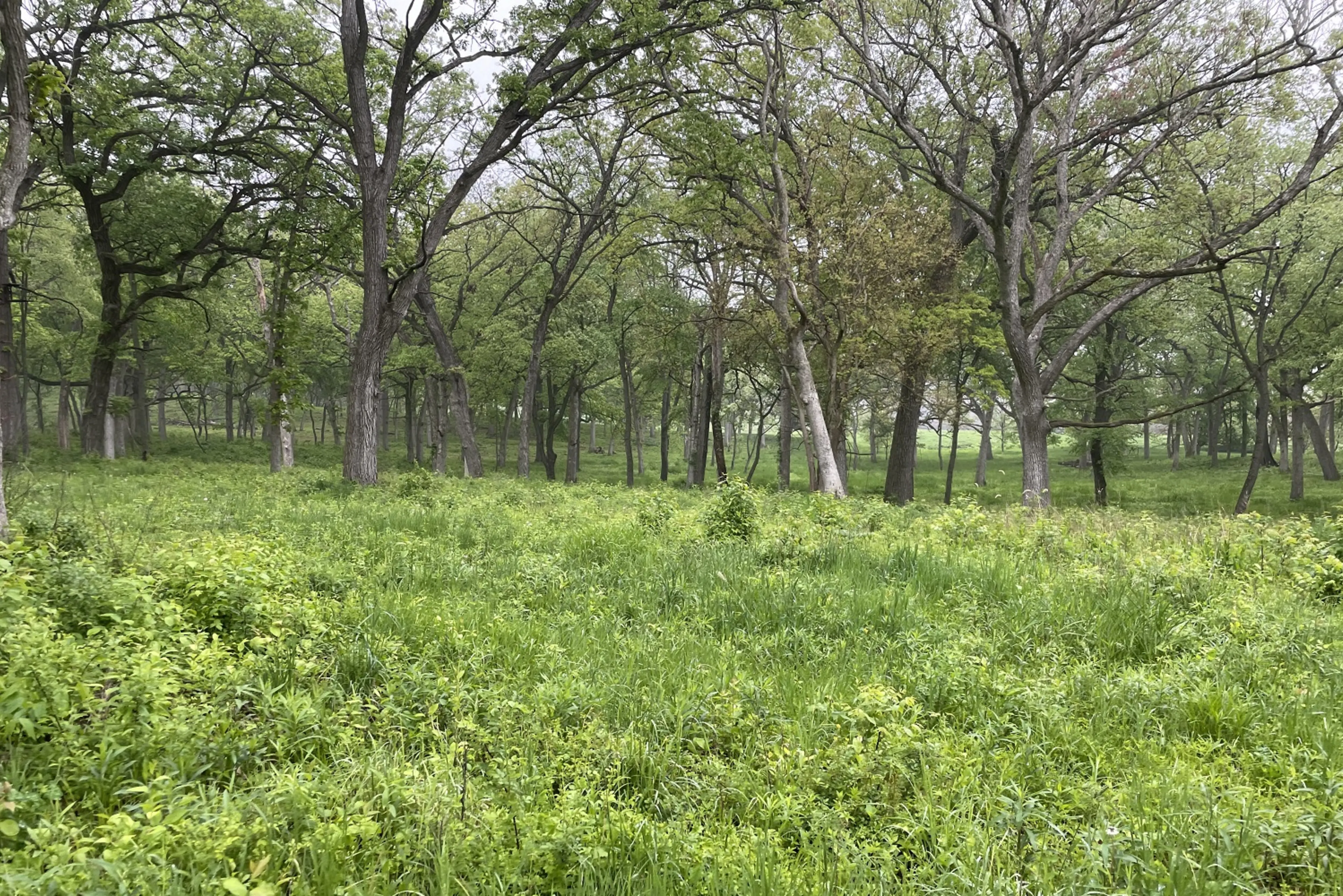
“I think we learned through the pandemic the power and importance of being outside, and how important that is for physical and mental health,” Emy Brawley, Illinois state director for the Conservation Fund, told WTTW News in Chicago. “To be able to be an hour from Chicago and stand somewhere where the only noises are the birds and the bees does wonders for mental health.”
“In many ways, acquisition of Tamarack Farms represents a ‘dream realized’ for a small group who first came together over two decades ago to advocate for its protection as part of the National Wildlife Refuge system,” said Steve Byers, chair of Friends of Hackmatack National Wildlife Refuge. “Protection of Tamarack Farms, with its majestic oak woodlands, dynamic wetlands and opportunities for prairie restoration, is a historic leap forward for the refuge and brings it closer to its goal of 11,200 acres of protected land.”