In the heart of the Pacific, Molokaʻi Land Trust is preserving Hawaiʻian land and culture
Molokaʻi supports a wide range of natural habitats, including rainforest-covered plateaus, forest understories composed of giant ferns and tiny flowers, and the country’s longest fringing coral reef.

On October 5, 1978, Congress passed a joint resolution, signed by President Jimmy Carter, establishing Asian/Pacific American Heritage Week. In 1990, Congress expanded the observance to a monthlong celebration. President Barack Obama renamed it Asian American and Pacific Islander Heritage Month in 2009, and President Joe Biden updated it in 2021 to Asian American, Native Hawaiʻian and Pacific Islander Heritage Month.
Hawai‘i, which became the 50th state in August 1959, is unique as the only U.S. state outside the North American mainland, the only state made up entirely of islands and the only state located in the tropics. It is also one of seven majority-minority states in the country, alongside California, Georgia, Maryland, Nevada, New Mexico and Texas, and the only state with an Asian American plurality. According to the 2020 U.S. Census, Hawaiʻi’s population of 1.46 million identified as 37.2% Asian, 25.3% multiracial, 22.9% White, 10.8% Native Hawaiʻian and other Pacific Islander, 9.5% Hispanic or Latino and 1.6% Black or African American.
Molokaʻi, Hawaiʻi’s fifth-largest island
Today, several land trusts are working in Hawaiʻi to preserve its land and culture, including the Molokaʻi Land Trust, based on the island of Molokaʻi. The land trust protects and restores natural habitats and preserves cultural resources and traditions on the island, the fifth-largest island in the Hawaiʻian archipelago. The island was formed approximately 1.5 million years ago by volcanic activity.
The Native Hawaiʻian community and residents of Molokaʻi have long resisted the pressures of tourism and large-scale development, choosing instead to nurture an agricultural economy and a more traditional lifestyle. Small-scale farms thrive on the island, cultivating cattle and a vibrant array of produce, including bananas, papayas, kalo, sweet potatoes, and other fruits and vegetables.
Molokaʻi also supports a wide range of natural habitats, including rainforest-covered plateaus, forest understories composed of giant ferns and tiny flowers, and the country’s longest fringing coral reef.

Recognizing the importance of natural habitats and the wildlife that rely on these areas, the Native Hawaiʻian community and residents are working to conserve natural habitats by creating sanctuaries such as the Kamakou Preserve, Molokaʻi Forest Reserve and Moʻomomi Beach Preserve.
An invasives invasion
Unfortunately, the island’s ecosystems face challenges from historical land practices and invasive species, such as non-native plants, feral pigs and goats. These pressures have led to the extinction of several native species, including the kokiʻo, a deciduous tree cotton that is now extinct in the wild, and the olomaʻo and kākāwahie, both of which are extinct bird species. More than 50 forest bird species once inhabited the Hawaiʻian Islands; however, only 20 species remain today. Their extinction has been accelerated by avian malaria, a disease transmitted by invasive mosquitoes.
In response, Molokaʻi Land Trust is working with partners and communities to restore native habitats and preserve cultural sites, both on and off its preserves. The land trust owns the Mokio Preserve and Kawaikapu Preserve, which protect a wide range of habitats, including remnant native forests and coastal strands. The preserves also contain Native Hawaiʻian archeological and cultural sites, including a fishing shrine and adze quarries. At least five naturally occurring federally endangered plant species are located on the Mokio Preserve, including the ʻihiʻihilauākea — an endemic, deciduous fern that resembles a four-leaf clover.
The land trust worked with the U.S. Fish and Wildlife Service’s Coastal Program to protect 90 acres of coastal habitat by installing predator-proof fencing that excludes invasive rodents, feral cats and other pests that threaten native plants, ground-nesting seabirds and pollinators, including the federally endangered Nalo meli maoli, or yellow-faced bees.
A win-win for Molokaʻi
Beyond preserving the biodiversity and cultural history of the island, Molokaʻi Land Trust works directly to help the local community as well. The preserves owned by the land trust offer subsistence hunting and fishing opportunities for locals. The organization also works with public and private schools to provide science, technology, engineering and mathematics learning and internship opportunities, helping local students and other community members develop the skills needed to pursue higher education in STEM-related natural sciences or careers in natural resource management.
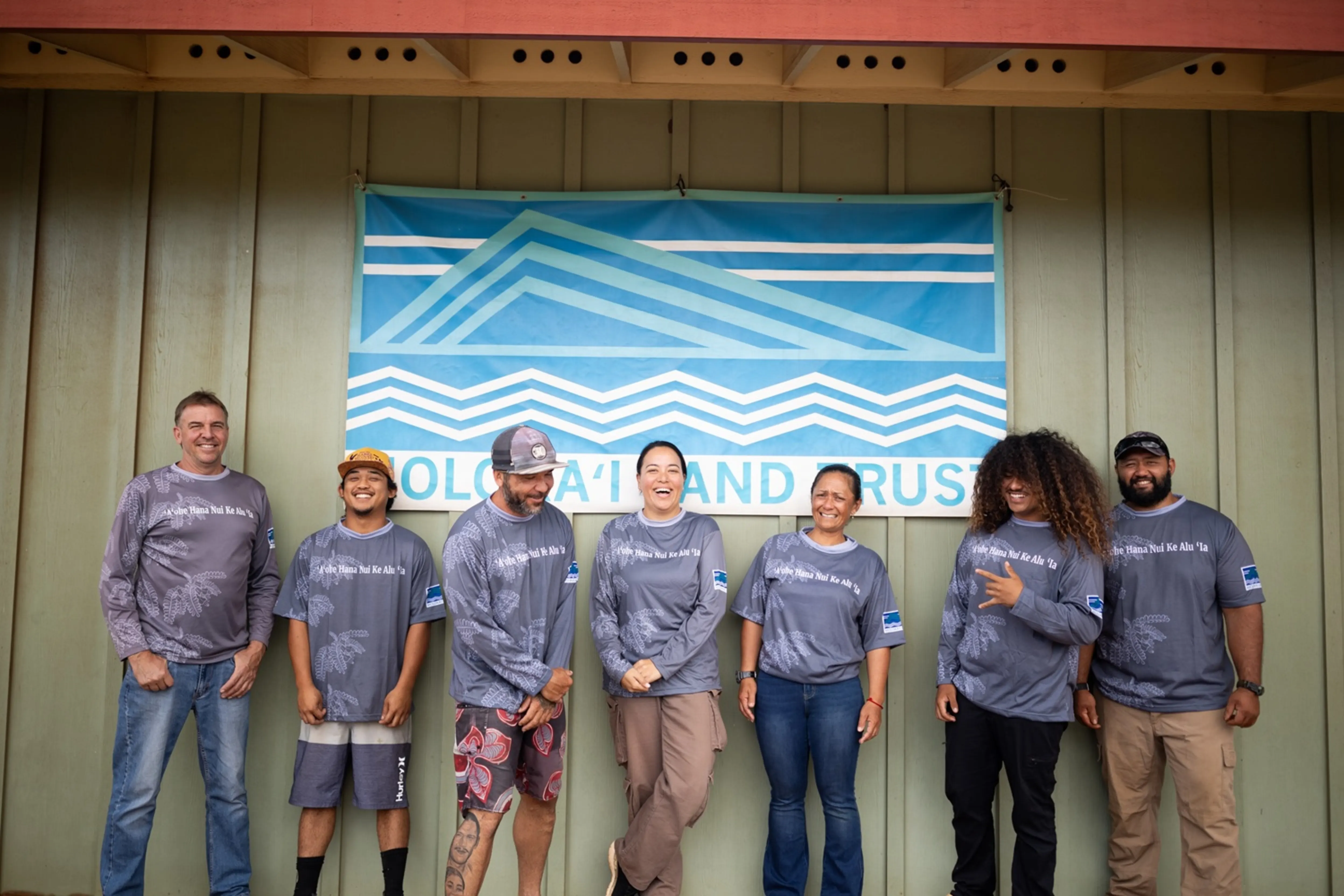
And, Molokaʻi Land Trust’s restoration work is providing annual economic contributions to the economy of the island.
Research shows that land conservation adds economic value by boosting local economies through tourism and jobs, health care savings, filtering drinking water, providing natural disaster mitigation, and more. A recent report on investments in nature, produced by the Land Trust Alliance and the U.S. Fish and Wildlife Service, found, for example, that habitat restoration completed by the Molokaʻi Land Trust and project partners supported approximately $326,000 of economic output in the local economy and as many as nine local jobs annually.
Further reading:
Investing In Nature: The Economic Benefits of Protecting Our Lands and Waters
Molokaʻi, Hawai‘i: The Friendly Isle
