Because of you
Land conservation is forever, and for everyone.
The land offers benefits that are essential to human well-being, including clean water and air, fresh food, opportunities to recreate and recharge, and buffers from some of the worst impacts of climate change.
Yet too many people do not have access to the land and its fundamental benefits. From rural communities to densely populated cities, land trusts work to conserve land.
And the Land Trust Alliance is committed to working with them to help ensure that every person — of any race, culture, income, age or ability — has equal access to green spaces, clean water, fresh air, nutritious food and many other benefits of nature.
Your support drives on-the-ground impact
For many years the Alliance has invested grant funds, ranging from leadership training to remote monitoring and land and climate grants to Rally scholarships, in the staff and programming at the accredited Mount Grace Land Conservation Trust. The impact is incredible.
In 2022, the Alliance presented the Massachusetts-based Mount Grace with a Land Trust Excellence Award, honoring, as Alliance CEO & President Andrew Bowman said, the organization’s journey to explore its work “using an equity-oriented lens.” As one example, Mount Grace partnered with Nipmuk Cultural Preservation, Inc., a nonprofit devoted to recovering, cultivating and promoting Nipmuc Native American culture and history, on a cultural use and respect agreement that “invites Nipmuc citizens to the land and reserves them rights beyond those granted to the general public, such as harvesting food and medicine, camping, and holding ceremonies on the land.”
Urgent work ahead
Mount Grace also recently launched a new Climate and Land Justice Program centered on the importance and urgency of climate change and equitable land access for everyone, especially Black and Indigenous farmers and farmers of color.
“When we protect land, we protect wildlife connectivity, biodiversity and good soils,” said Emma G. Ellsworth, executive director at Mount Grace. “We also protect generational relationships with the land. That’s at the core of Mount Grace’s mission. It’s at the core of the very urgent work ahead of us all. Not to protect the land from people, but to restore our relationships with the land and each other for a more just and equitable future.”
This work is something we can all be proud of. Thank you for ensuring land conservation is for everyone.


A critical victory for private land conservation
After years of hard work and persistence by the Land Trust Alliance, our supporters, land trust members and our allies on Capitol Hill — and in the face of well-resourced opposition — Congress finally passed the Charitable Conservation Easement Program Integrity Act.
The Alliance thanks a bipartisan group of congressional leaders, including Sens. Steve Daines, Chuck Grassley, Debbie Stabenow and Ron Wyden, and Reps. Mike Thompson and Mike Kelly, for leading the effort to halt this abuse and ensuring that the legislation was part of the year-end appropriations bill.
A conservation easement, on its face, is a simple concept: A voluntary legal agreement between a landowner and a government agency or land trust that permanently limits future development of the land to protect its conservation values.
But the significance of this tool goes well beyond its status as a straightforward legal instrument: Conservation easements are at the heart of private land conservation, allowing landowners to protect their land into the future on their own terms, while still retaining the ability to own, use and control their land, sell it or pass it on to heirs.
While the vast majority of these donations are good-faith charitable endeavors, unfortunately, a few bad actors sought to game the system in pursuit of quick — and often staggeringly outsized — profits.
A long time coming
This victory was a long time coming yet was in no way guaranteed. Promoters of abusive conservation easements lobbied aggressively on Capitol Hill. Thankfully, our community of land trusts worked with a group of congressional leaders and held steadfast in their commitment to stopping the abuse.
A heartfelt thank you goes to you and all our loyal supporters, in addition to everyone who took the time to make their voices heard and insist that Congress step up and do the right thing. Now that’s something to celebrate.
Strengthening relationships at Advocacy Days
110 in-person meetings with members of Congress
108 land trust leaders, from 31 states, virtual and in person
40 first-time participants
17 former or current land trust board members
10 members of the Alliance’s Leadership Council
Water is life
You are helping protect it.
There is a fundamental relationship between land conservation and water quality: The protection of upstream water sources is needed to ensure safe, reliable and affordable water for all people.
In fact, the Alliance is expanding its water work and in 2022 granted special funds to grow land trusts’ capacity to better address these issues at the local level. And it’s all thanks to you.
Calvert County, Maryland, is surrounded by water on three sides, with the Chesapeake Bay to the east, the Patuxent River to the west and the Mill Creek drainage in the middle feeding directly into both. The sounds and smells of water, birds and lush green plants envelop the senses.
“That beautiful setting is what brought most of us here to live and it is the focus of great appreciation. However, it was eventually recognized that appreciation alone would not guarantee the continued health and viability of those waterways,” said Ted Hayne, lecturer at Towson University in Maryland.
The harsh reality is that access to clean water is neither guaranteed nor equitable in the Chesapeake Bay area. Some communities have lost access to clean water or experienced water-related disasters.
The good news is that, with Alliance grant funds, the accredited American Chestnut Land Trust was able to strategically focus resources, collaborate with community members and protect precious waterways for all people in the region.
“Grant support from the Alliance has helped us to build ‘friends’ groups and begin water quality monitoring of our water. In 2022 we monitored over 50,000 acres of watersheds. And next year, more!” exclaimed Greg Bowen, ACLT’s executive director. Through its leadership of the Southern Maryland Conservation Alliance, ACLT was able to support the birth of the Friends of Mill Creek and numerous other collaborative groups to protect and restore ecosystems in the five-county Southern Maryland region.
“I have always believed that the last/best step to save the Chesapeake Bay is to have local watershed groups experience, enjoy, monitor and advocate for their own waterways.”
Land trusts are uniquely positioned to lead water quality initiatives that are critically important to communities where they work. Heartfelt support from incredible donors across the country is what makes this possible.
Inspiring youth who care
Did you know, according to a recent study by Seattle Children’s Research Institute, the average child plays outside less than 15 minutes a day?
It’s having adverse effects on their physical and emotional well-being. Not to mention it is directly linked to whether they care about land, water and wildlife or where their food comes from.
To maintain wild spaces and advance future land protection, the next generation needs to learn how to care about and for the land.
That's why the Alliance invested in the Great Peninsula Conservancy's Land Labs program. The accredited land trust brings students to protected lands on the Puget Sound in Washington, teaching them practical, hands-on science lessons while fostering a love of the natural world, close to home.
Land Labs students also have the chance to meet professionals and experts with careers in scientific and environmental fields. The fifth, sixth and seventh-grade students who participate in Land Labs are typically from underserved schools. Many Land Lab students have lacked opportunities to spend time in nature.
Great Peninsula Conservancy hopes that students will leave Land Labs lessons feeling empowered as environmental stewards and inspired to explore future careers in STEM fields.
GPC's Land Labs sites are chosen for their accessibility and ability to accommodate visitors, such as Curley Creek Tyner Preserve, 28 acres of forest along an important fish-bearing stream that supports endangered steelhead and Chinook salmon. Students visiting the preserve record observations in journals, monitor the ecosystem and invasive plant species, and study organisms and habitats up close.
The Alliance's investments extended to curriculum development at Land Labs sites, such as Grovers Creek Preserve, where the material teaches students how to improve the biodiversity of the forest and why it is critical to a climate-resilient future.
"Many students don't have the opportunity to get out on the land. But the students who participate in Land Labs have the opportunity to forge a meaningful relationship with nature that we hope will serve them throughout their lives."
The southeastern corner of Oregon is an arid and vast mosaic of aspen woodlands, grasslands, creeks, wet meadows and sagebrush-steppe.
It is home to rare plants that fuel life throughout the year, supporting many birds and wildlife such as California bighorn sheep, pygmy rabbit and pronghorn antelope, as well as vulnerable species like greater sage-grouse and Lahontan cutthroat trout.
Unfortunately, these special lands and wildlife face immense pressure from a changing climate and poorly planned development.
So, when Oregon Desert Land Trust had the opportunity to secure nearly 17,000 acres between the Pueblo and Trout Creek mountains last year, they saw unparalleled potential to build a connected, climate-resilient landscape linking more than 1 million acres of wildlife habitat. That’s roughly the size of the Grand Canyon.
To accomplish a large-scale project like this, ODLT sought funding and support from the Alliance to help cover acquisition costs of the land.
With this grant funding and strong partnerships with the landowner and The Nature Conservancy, ODLT will continue to work to connect these natural and working lands that benefit wildlife, people and the planet.
The project area encompasses nearly 800 square miles and helps connect several established conservation areas, including two national wildlife refuges and a wilderness area. Many of the nearby mountain streams and springs flow to Oregon’s driest spot—the Alvord Basin—providing critical water to a desert landscape that typically gets only 7 inches of rain per year.
Protecting water sources like these can make all the difference in a desert climate, especially for wildlife.
Thanks to you and many other supporters, this land in the Pueblo and Trout Creek mountains is protected forever, keeping the land intact and more resilient to drought, fire, flood and invasive species.
“The Alliance’s support has allowed us to take on conservation projects at a scale that would have been unthinkable just five years ago.”
Our promise of perpetuity
It is no secret that going to court is expensive and time consuming. Land trusts succeed when they are prepared to meet the administrative, financial and people costs of litigation.
Heading off disputes early and having strong resolution skills for differences with landowners and neighbors can reduce the risk of lawsuits. Eventually, however, upholding lasting conservation may force a land trust into court.
Land trusts are not on their own, however. Thanks to your generous support of Alliance programs, land trusts have the help they need to navigate these challenges. Our conservation defense team provides resources and support to help land trusts develop necessary procedures to uphold their promise of forever, while staying on solid legal and financial ground.
As part of this strategy, we are constantly providing new Practical Pointers, available in the enhanced online Resource Center, to keep land trusts informed and help them navigate the risks associated with specific legal challenges to land conservation.
But our work to safeguard conservation goes well beyond that. The Alliance provides legal vigilance and dedication on behalf of the land trust community to identify and monitor new legal developments as they come up.
For example, in the case of Michigan Department of Agriculture and Rural Development v. Engle, the Michigan Appellate Court recently handed down a victory for conservation and conservation easements, illustrating the power of conservation partnerships and just how strong we can be together.
When landowners in Acme Township, Michigan, sought to sell off a parcel of conserved farmland in violation of a valid conservation easement, the Alliance partnered with Grand Traverse Regional Land Conservancy, Heart of the Lakes (the Michigan state land trust association) and American Farmland Trust to file a joint amicus brief — a well-researched legal argument supporting the conservation easement — that helped ensure the win.
That win sends a resounding national message that conservation advocates keep their promises to steward the land in perpetuity and that the Alliance supports land trusts every step of the way.
Conserved lands will continue to face legal threats. But your continued investment ensures the promise of perpetuity will stand the test of time.
More good news
Everything conservation in the Resource Center
The Resource Library, which holds thousands of documents, samples, events, courses and more to help land trust practitioners learn and grow. The new, more powerful site lets you search all of our resources, including documents, webinars and other events. Filter your results by topic, tag, expertise level and more.
Online conversations to join, including the stewardship topic area, Ask an Expert, Communicators’ Network and more, so you can connect with other conservationists on topics that matter most to land trust staff, board and volunteers.
Support from professional, government and nonprofit members of the Alliance through the Affiliate Member Directory.
Field Services Programs, where land trust staff can find their region to learn how the Alliance can assist with resources, training, funding opportunities and more.
Guidance and samples for implementing each of the Standards and Practices.
And many more ways to learn, including online courses, publications, Practical Pointers, webinars, an archive of Saving Land magazine and so much more.
To access the Resource Center, use your existing Learning Center login; if you don’t remember your password, it’s easy to reset or create a new one.
The Resource Center was made possible by funding from an anonymous foundation and our awesome supporters and partners. It’s the most comprehensive source of in-depth, relevant content for volunteers, staff and board members of land trusts and all conservationists to learn, connect and grow. We hope you enjoy this incredible conservation tool.
Access the Resource Center
In the upper right corner of this website click the “Resource Center” button
Log in and expand your learning, connections and opportunities. If you do not know your password, click the “forgot password” link, enter your email address and we’ll send you a link to create a new password.
You made all the difference
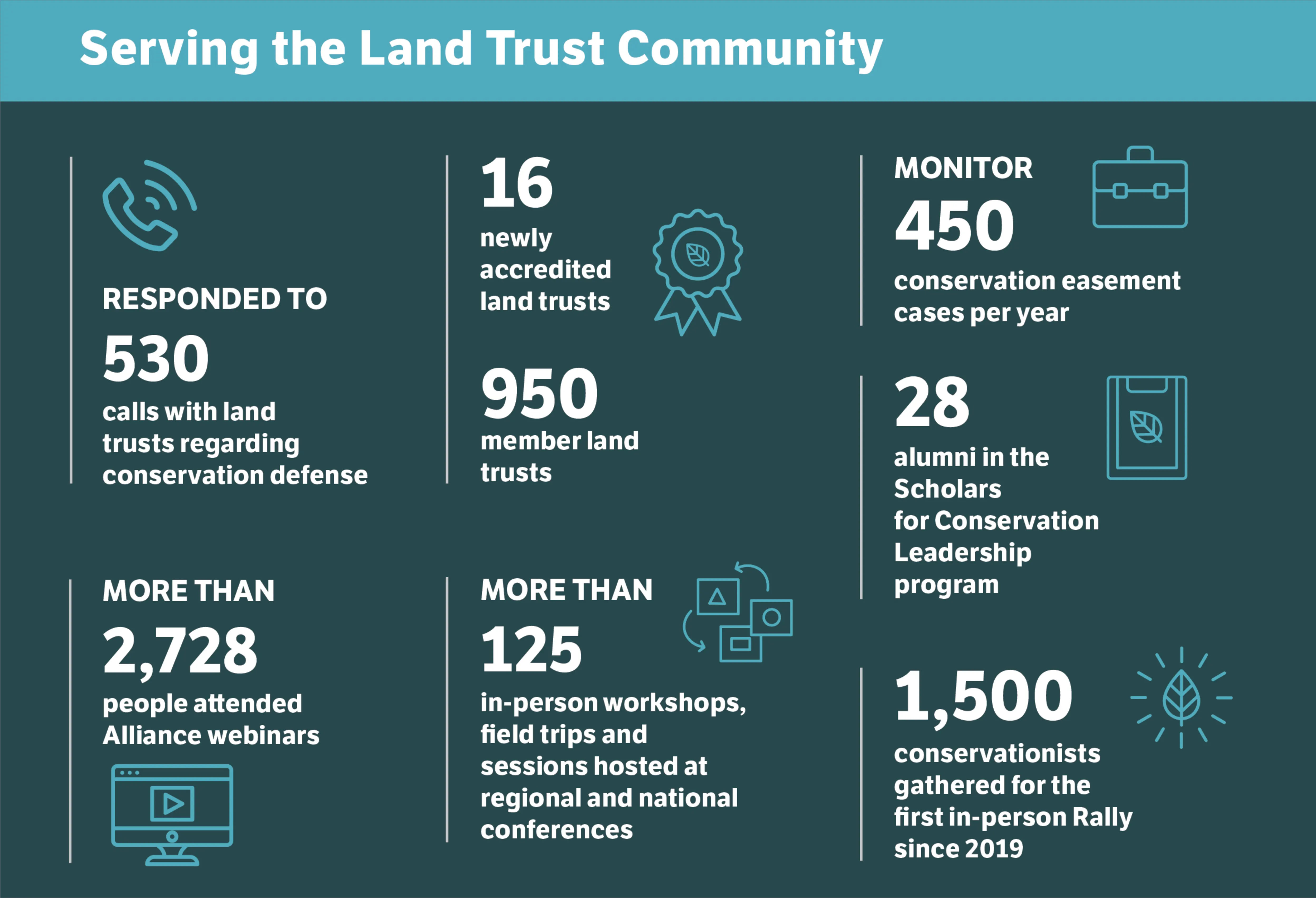
129
new individual supporters and partners
3,243
new land trust volunteers, board and staff members
Why we give
"Our partnership with the Land Trust Alliance underscores our commitment to supporting important causes and inspiring others to give back as well.”
Why I give
“Land trust work is complex, it takes time to learn it and understand it. I really appreciate how much the Alliance invests in leadership of executive directors and boards, because without that investment, land conservation would look very different.”
— David Calle, new Land Trust Alliance board member in 2022